Decoded: The Hidden Symbolism of Amazigh Patterns
Before becoming a decorative piece admired all over the world, the Berber rug was an intimate object, woven by women for their own homes. Rooted in Amazigh culture, its patterns form a vocabulary handed down from generation to generation, used to express wishes, protection or moments of life.
Let us be clear from the start: there is no single dictionary. Meanings vary from one region, tribe and family to another, and each weaver keeps her own share of interpretation. The readings below are the ones most commonly encountered.
The diamond: protection and femininity
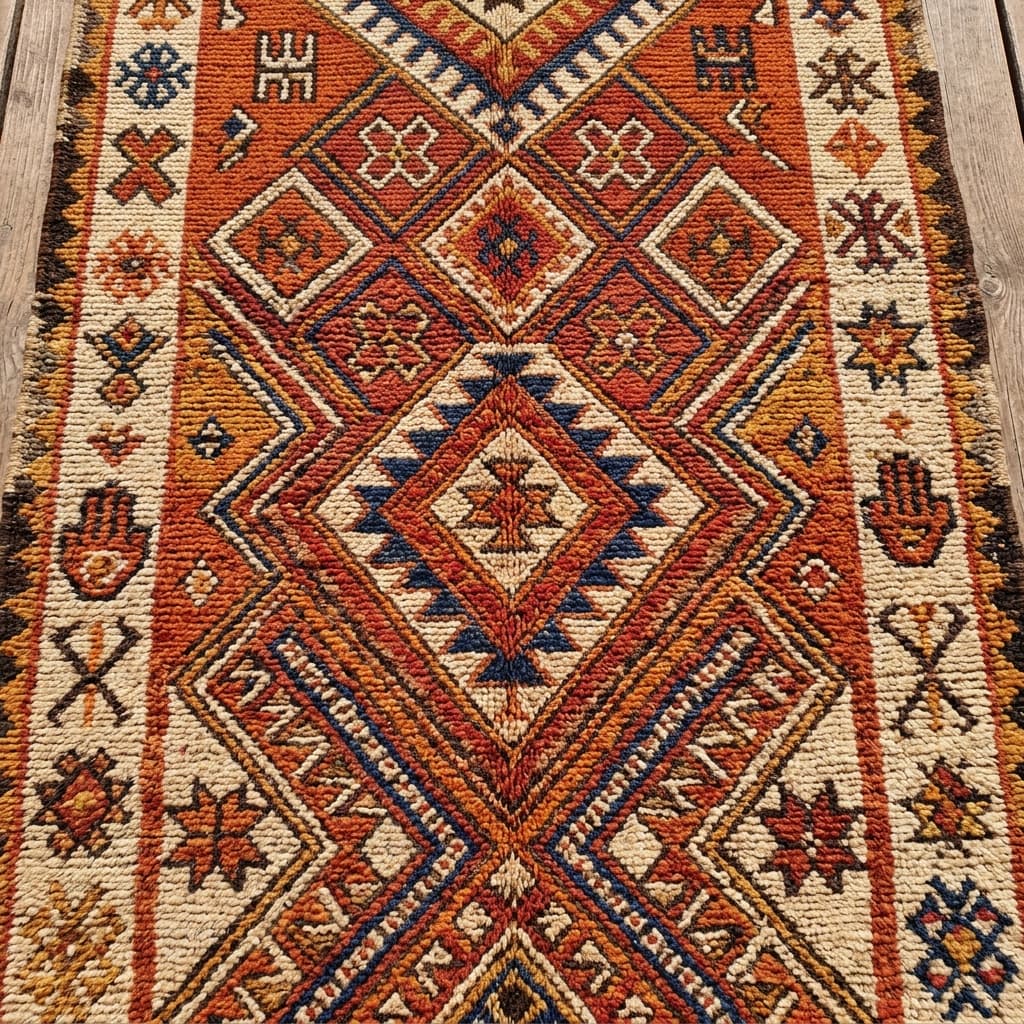
This is the most widespread motif. Often likened to an eye, it is woven to protect the home from the evil eye. Adorned with small hooks or repeated as a lattice, it evokes fertility, femininity and the continuity of the family. On Beni Ouarain rugs, the large brown diamonds on a cream background are its most graphic expression.
The zigzag: water and the path
Broken lines often represent water: rivers, springs, irrigation. In the arid regions of the Atlas, water means life and prosperity. They can also be read as the path, the journey and the transhumance routes of herds between plains and mountains.
Crosses, chevrons and lines
- The cross and the X: protection, but also meeting and the crossing of paths.
- Chevrons and herringbones: abundance and fertility.
- Parallel lines: the passing of time, successive generations.
- The ⵣ (yaz) symbol, a letter of the Tifinagh alphabet that became the emblem of Amazigh identity: the 'free man'.
A style for each region
Each family of rugs has its own grammar. The Beni Ouarain, from the Middle Atlas, uses sober diamond lattices in natural, undyed wool. The Mrirt shares this aesthetic with finer, denser wool. Flat-woven kilims play with bands and more colourful geometric motifs. Finally, Azilal rugs and Boucherouite give free rein to colour and improvisation.
Imperfection, a sign of authenticity
On a hand-knotted rug, patterns are never perfectly symmetrical. A wider diamond, a line that drifts, a colour that changes from one dye bath to the next: these irregularities are the signature of human work. According to an often-quoted tradition, only divine creation is perfect; whether or not you believe it, each 'imperfection' is a reminder that a woman knotted this rug, knot after knot.
Choosing a Berber rug means welcoming a meaningful piece into your home. Look closely at its patterns: you may discover the story its weaver wanted to tell.